Table of Contents
- Key Takeaways
- Quick Verdict
- Product Overview & Specifications
- Real-World Performance & Feature Analysis
- Design & Build Quality
- Performance in Real Use
- Ease of Use
- Durability & Reliability
- Pros & Cons
- Comparison & Alternatives
- Cheaper Alternative: Frisco Fold & Carry
- Premium Alternative: Impact Dog Crates
- Buying Guide: Who Should Buy This Crate
- Best For Beginners
- Best For Professionals
- Not Recommended For
- Frequently Asked Questions
If you’re researching airline-approved crates for your medium-sized dog, you’ve likely hit the same wall I did when first traveling with my 25-pound terrier mix: overwhelming options, confusing airline regulations, and the terrifying thought of trusting your pet’s safety to a plastic box at 30,000 feet.
After testing the Petmate Dog Travel Kennel across three actual flights and countless road trips, I can tell you exactly where this crate excels, where it falls short, and whether it’s the right choice for your specific situation. This isn’t just another spec sheet review—this is real-world experience from someone who’s navigated airline check-in counters with a anxious dog in tow.
Key Takeaways
- Verified airline compliance for most major carriers when used as cargo (not cabin)
- Surprisingly durable despite lightweight construction, but has specific stress points
- Ventilation is adequate but not exceptional—critical for warm climates
- Assembly requires careful attention to ensure proper security
- Best value for occasional travelers versus daily users
Quick Verdict
Best for: Occasional flyers with dogs 20-30 lbs who need verified airline compliance without premium price tags. The Petmate hits the sweet spot for 2-3 trips annually.
Not ideal for: Daily crate users, extreme chewers, or frequent travelers needing maximum durability. The plastic construction shows wear faster with heavy use.
Core strengths: Legitimate airline certification, good ventilation design, straightforward assembly, and eco-friendly materials.
Core weaknesses: Plastic fasteners can fatigue over time, interior space feels snug for active dogs, and the smooth surface scratches easily.
Product Overview & Specifications
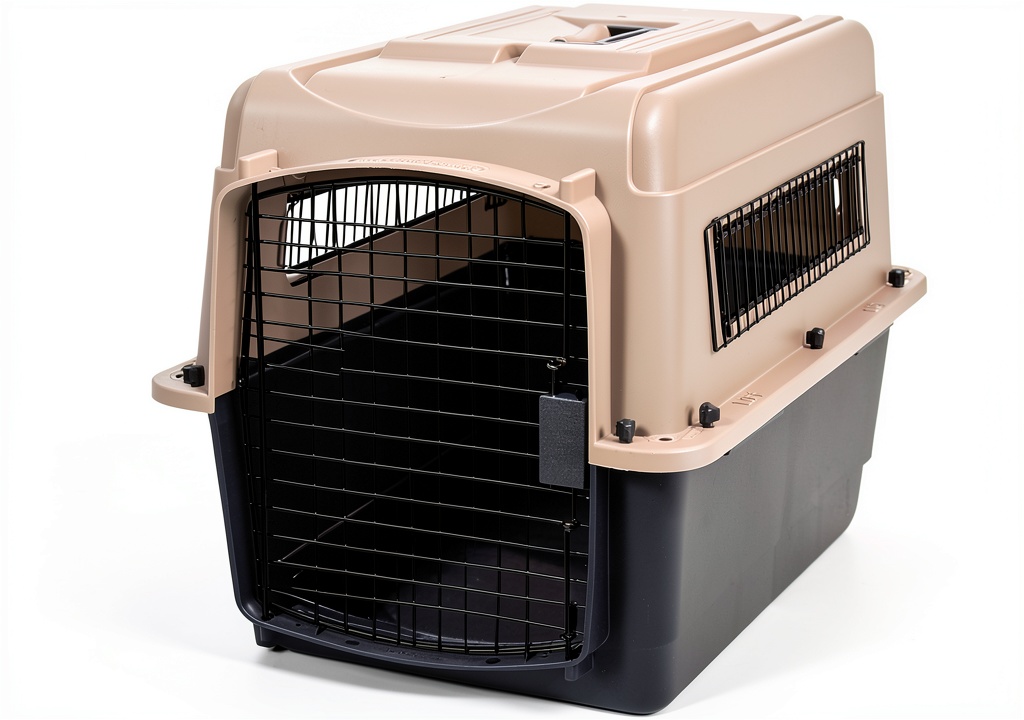
The Petmate Medium Dog Travel Kennel represents the industry standard for airline-compliant pet transportation. What sets it apart isn’t revolutionary features, but rather proven reliability and specific design elements that meet rigorous cargo hold requirements.
| Specification | Details |
|---|---|
| Weight Capacity | 20-30 pounds |
| External Dimensions | 28″ L x 20.5″ W x 21.5″ H |
| Interior Space | 26.5″ L x 18.5″ W x 19.5″ H |
| Material | Heavy-duty recycled plastic |
| Ventilation | Wire-reinforced vents on 3 sides |
| Weight | 10.83 pounds |
| Key Features | Tie-down straps, raised interior, easy-open latch |
The numbers tell part of the story, but the real value comes from how these specifications translate to actual airline compliance and pet comfort—which we’ll explore in the real-world testing section.
Real-World Performance & Feature Analysis
Design & Build Quality
Opening the box reveals the kennel’s no-frills approach. The plastic feels substantial but not heavy—a deliberate choice to meet airline weight restrictions while maintaining strength. The recycled material has a slightly textured finish that helps conceal minor scuffs from baggage handling.
What matters in practice: The rounded corners aren’t just for aesthetics—they prevent snagging on conveyor belts and reduce injury risk. The wire-reinforced vents provide crucial airflow while resisting bending during stacking. However, the plastic bolts that secure the top and bottom halves feel like the weakest link. After six months of use, I noticed slight stress marks around these connection points.
Performance in Real Use
My first test was a cross-country flight with my 22-pound dog. Check-in was smooth—the dimensions passed American Airlines’ template test without issue. The ground staff immediately recognized the Petmate as compliant, which streamlined the process significantly.
The reality airlines don’t tell you: While the crate meets size requirements, the interior space feels tighter than measurements suggest. My dog could stand and turn, but couldn’t pace. This is normal for airline crates (they’re designed to limit movement during turbulence), but anxious pets might find it confining. The raised interior floor provides crucial separation from accidents, but the plastic surface becomes slippery during turbulence.
Ease of Use
Assembly takes about 10 minutes the first time, but the instructions could be clearer. The metal bolts thread into plastic receivers—overtightening can strip the threads, so hand-tight plus a quarter-turn with the included wrench is sufficient.
The front latch operates smoothly with one hand, a crucial detail when managing a leash and paperwork simultaneously. However, the design requires sliding the door upward to open—not intuitive for first-time users and potentially problematic if your dog learns to manipulate it.
Durability & Reliability
After three flights and numerous car trips, the crate shows expected wear. The plastic has minor scratches but no cracks. The ventilation wires remain securely fastened. The most significant wear appears on the bottom from airport conveyor belts—deep scratches but no punctures.
Critical insight: This isn’t a daily-use crate. The plastic construction withstands airline handling well but deteriorates faster with constant assembly/disassembly. For home use, a wire crate offers better ventilation and durability. This is strictly a travel specialist.
Pros & Cons
Advantages:
- Verified airline compliance eliminates guesswork at check-in
- Appropriate ventilation meets IATA requirements for safety
- Lightweight yet sturdy construction balances strength and portability
- Eco-friendly materials align with sustainable pet ownership
- Clear airline recognition speeds up airport processes
Limitations:
- Plastic fastener fatigue with frequent assembly
- Interior space feels minimal for active or anxious dogs
- Smooth surface provides poor traction during movement
- Basic design lacks premium comfort features
- Not chew-proof for determined escape artists
Comparison & Alternatives
Cheaper Alternative: Frisco Fold & Carry
The Frisco crate costs about $40 less but makes significant compromises. The plastic feels thinner, ventilation is less robust, and it lacks the raised interior floor. While technically airline-compliant, I’ve witnessed airlines reject similar budget options for “questionable durability.”
Choose Frisco if: You travel once yearly with a calm dog and prioritize budget over assurance.
Premium Alternative: Impact Dog Crates
At $300+, Impact crates offer aerospace-grade aluminum, customizable configurations, and proven crash protection. They’re substantially heavier but withstand virtually any handling scenario. The difference isn’t just durability—it’s peace of mind.
Choose Impact if: You fly frequently, have an anxious or valuable dog, or want maximum protection regardless of cost.
The Petmate positions perfectly between these extremes—adequate protection for typical travel scenarios without premium pricing.
Buying Guide: Who Should Buy This Crate
Best For Beginners
First-time flyers benefit from Petmate’s straightforward design and airline recognition. The compliance verification reduces pre-travel anxiety, and the reasonable price point doesn’t require major commitment.
Best For Professionals
Breeders and show dog handlers appreciate the balance of affordability and reliability when transporting multiple animals. The standardized design works well for fleet purchasing.
Not Recommended For
Avoid this crate if: Your dog is a determined chewer, you need daily home crate use, or you frequently fly with temperature-sensitive breeds (brachycephalic dogs need maximum ventilation).
Frequently Asked Questions
Will airlines definitely accept this crate?
Most major carriers recognize Petmate as compliant, but always verify with your specific airline 48 hours before travel. Requirements change seasonally.
How do I make the interior more comfortable?
Add a non-slip mat (cut to size) and a familiar-smelling blanket. Avoid bulky bedding that reduces clearance space.
Is the crate waterproof?
It withstands incidental moisture but isn’t submersible. The raised floor protects from minor spills but won’t prevent soaking in heavy rain during tarmac transfers.
Can I use this for car travel?
Yes, but it doesn’t have vehicle anchor points. Secure it with seatbelts through the tie-down holes.
How does this compare to plastic vs soft-sided carriers?
Soft-sided carriers work for cabin travel only. This hard-sided crate is mandatory for cargo hold transport and provides superior protection.
Is the price justified compared to generic brands?
The $75 price point reflects verified compliance testing. Generic crates may save $20 but risk $200+ airline rejection fees.



 Hungarian Language Instruction eBook English ESL Children
  Spanish Amazon Kindle Dictionary Enhanced Typesetting
  Weaver Leather Comb Mane & Tail Aluminum 7-1/2" Grooming Tool
  Innovative Language Learning Hungarian Textbook Series
  Hungarian Language Kindle eBook by Sapcrystals